
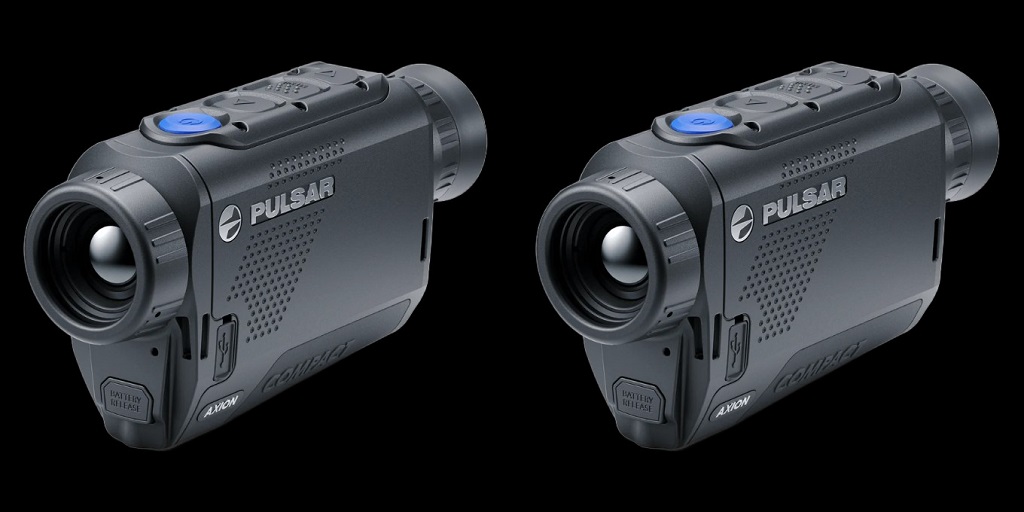
Thermal binoculars are popular among some night hunters, and for a few good reasons. Among these are that binoculars sport a familiar form factor (glass optic binoculars are among the most popular optics out there) and also, thermal binoculars let you use both eyes, helping to prevent discomfort in the dark.
This post will cover two excellent options in PULSAR thermal binoculars, the Symbion LRF DXR50 and DXT50. Here’s what they offer.
What They Have in Common
First, let’s take a look at what these PULSAR thermal binoculars share:
- A 1600-yard laser rangefinder that enables quick, precise distance measurements and eliminates guesswork. Also, the LRF enables single measurements and continuous scanning.
- Classic binocular footprint and ergonomics. These thermal binoculars offer compact form factor and a sleek profile that packs comfortable and fits nicely in the hand.
- Conveniently-located controls; there are 8 buttons easily accessible at the top of the unit.
- They can be used during the day or night, and adapt seamlessly to provide clear image quality.
- Multispectral imaging capabilities that accommodate both thermal and night vision.
- Wi-Fi compatibility that enables both Symbion LRF thermal binoculars to enjoy easy connectivity with your wireless devices, wireless software updates, and more.
- Compatibility with an app that allows for remote control of the device.
- Both of these PULSAR thermal optics deliver excellent image quality across the entire variable magnification range, variable zoom improves focus and preserves quality regardless of the level of magnification, resulting in crisp, clear, detailed images.
- Onboard photo and video recording so you can capture the details of your trip/hunt, with 64gb of internal memory. File transfer via USB-C is easy, too.
- Both these PULSAR thermal binoculars support 8 color display color palettes, which can be tailored to conditions, specific tasks, or just personal preference. Among these are low-light suitable palettes such as red monochrome, which helps to preserve night vision.
Specific to the Symbion LRF DXR50
The Symbion LRF DXR50 is the more affordable of these two PULSAR thermal binoculars, and offers, among the following:
- A 640×480, 12μm thermal sensor with a NETD rating of about 35mK.
- An 8.8 degree FOV, offering a 15.4 meter FOV at 100m.
- The better magnification capabilities of the two, from 4-32x, delivering strong ability to view far off targets.
- A more attractive price point when compared to the Symbion LRD DXR50
Specific to the Symbion LRF DXT50
The Symbion LRF DXT50 offers a few different specifications compared to the DXR50:
- A 1280×1024, 12μm thermal sensor with a NETD rating of about 40mK. Though the NETD rating is slightly inferior to the DXR50, the thermal sensor offers higher resolution.
- A wider, 17.5 degree FOV, showing 30.7m at 100m.
- Variable magnification of 2-16x.
Which Is for You?
At the end of the day these PULSAR thermal binoculars have more in common than different.
Consider the DXR50 if:
- You want to save a few dollars.
- You want the benefit of higher variable magnification.
- The lower sensor resolution isn’t a concern for you.
Go with the DXT50 if:
- You want the higher sensor resolution.
- Higher variable magnification is not a selling point for you.
- You want a wider field of view at greater ranges.
Interested in a Pair of PULSAR Thermal Binoculars?
Want to learn more about these PULSAR thermal optics or get a professional’s take on which one is best for your application? Learn more at Dark Night Outdoors or give them a call directly at 309-781-8421. They’ll cover the details and even make personalized recommendations for thermal optics based on your intended use case.
For more information about Iray USA and Thermal Rifle Scope Please visit: Dark Night Outdoors LLC.