
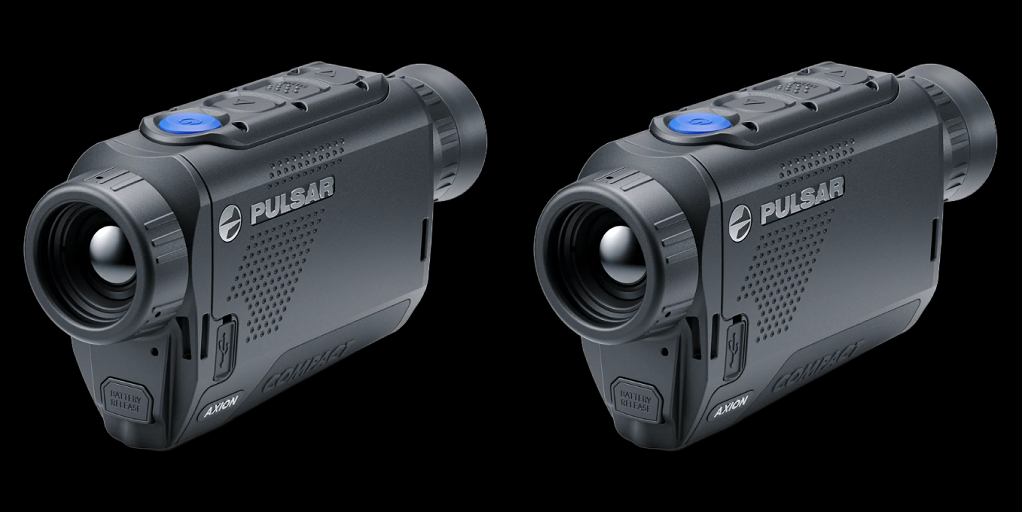
Fundamentally, thermal monoculars and binoculars do the same thing. They capture infrared radiation and then display a thermal image. They are primarily used for scouting, scanning and tracking and are widely used by night hunters, though they have other applications in law enforcement and search and rescue as well.
The only real manner in which they differ is in the form factor, assuming all other specifications, like sensor resolution and NETD rating, are held constant.
So when should you choose one over the other, considering the expense, which is not insignificant?
More often than not, it’s a matter of what you’re looking for; here are several ways a thermal monocular might be a better investment for you.
When You’re Sensitive to the Weight and Size
A pair of thermal binoculars is like a monocular, just twice the size and weight. Every loadout looks different and if you’re lugging around a lot of gear, sometimes the smaller size and more compact footprint of any piece of gear is a strong selling point.
This extends to thermal optics, too. Since thermal monoculars are generally lighter and more compact than binoculars, sometimes they just make more sense for hunters that need to trim down what they’re carrying.
If You Have a Problem with Night Blindness
Thermal binoculars are intended to be viewed with both eyes. The problem is that this can cause night blindness in both eyes simultaneously, even if you set the display to a low-light friendly color palette like crimson or viridian.
For many, this is just part and parcel of night hunting (though unfortunate). But temporary loss of visual acuity in both eyes is not something that many hunters can readily accept.
Thermal monoculars offer an out, since they are only intended to be viewed with one eye. This can leave you at least one eye well-adjusted to the dark. And, again, you can set the color palette of the display to a low-light friendly option to help mitigate the issue even if you can’t prevent it entirely.
If You Need a Versatile Option
Some thermal monoculars can do double and even triple duty, depending on whether they are handheld-only or if they are more compact and come with mounts.
Many thermal monoculars come with mounts and can be helmet mounted or even serve as a clip-on thermal optic.
This latter option is particularly valuable because, with thermal monoculars that offer this feature, it enables them to be clipped onto your rail and to convert your existing glass optic into a thermal scope, without the need to adjust or re-zero the scope.
In this capacity your purchase of a thermal monocular can really be more like several thermal optics in one; binoculars, as a result of their form factor, can’t offer this
When You’re Price Sensitive
Lastly, it’s impossible to overlook the fact that many thermal monoculars are considerably more affordable than equivalent binoculars. This of course assumes you keep all important specifications equal, such as the sensor resolution, frame rate and NETD rating.
All the same, if price point is a sticking matter for you, a monocular may just deliver the best value; it will almost certainly command a lower price.
Visit Dark Night Outdoors
At the end of the day, though thermal monoculars do offer some relative advantages over binoculars, there is no hard winner here. It’s about what you want or need.
Regardless, whether you’re looking for a monocular, a new pair of binoculars or a more specialized thermal scope, visit Dark Night Outdoors or contact them directly at 309-781-8421. They carry a wide inventory, represent the best brands, and can help you find what you need.
For More Information About Rix Thermal Scope and Best Thermal Scope Please Visit: Dark Night Outdoors LLC.