
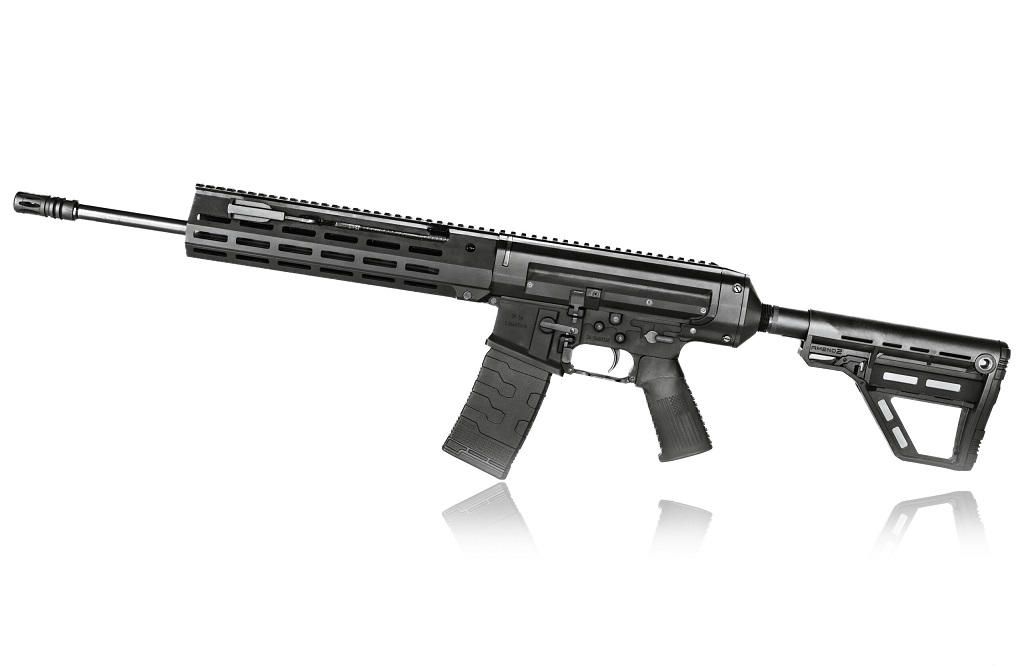
It’s not uncommon for handguns to feature direct blowback action, which relies effectively on chamber pressure and tuned bolt mass, barrel length and springs to cycle the action.
Direct blowback is simple in operation, and given the right circumstances, can be relatively reliable. That said, roller-delayed blowback operation, featured on famous subguns like the HK MP5 in addition to Zenith Firearms’ MRDS platform, is better by almost every metric.
Here’s what you should know.
Why Roller-Delayed Blowback?
Whereas direct blowback operation relies almost solely on the interplay of chamber pressure and bolt mass and recoil spring pressure to cycle, in a roller-delayed blowback system, rollers in the bolt delay the opening of the action until the chamber pressure drops to a safe level before unlocking and cycling.
As you might imagine, this offers numerous advantages over direct blowback, and in some cases, even a few over gas impingement, if we’re talking about rifle cartridges. Here are some of them.
- Less reciprocating mass, less recoil. Roller-delayed blowback actions require less bolt mass since they rely on their rollers, not just the mass of the bolt and the pressure of the spring, to keep the action closed until the pressure drops enough to cycle the action. This results in considerably lower reciprocating mass, which reduces recoil substantially over direct blowback actions.
- For AR and ARP fans: No buffer system. Autoloading rifles, especially rifles like AR-style platforms, rely primarily on gas impingement action or gas piston action to cycle their actions. These are very reliable with rifle cartridges and they can be tuned, but they also require a buffer system to operate. The buffer system adds weight to the platform and extends the profile as well. Roller-delayed blowback firearms lack a buffer tube so they can be lighter and more compact.
- They handle suppression better. Direct blowback firearms can be suppressed, but because the suppressor increases bore pressure considerably, it usually results in a lot of port pop that counteracts the effects of the suppressor. Since roller-delayed blowback actions stay locked for longer, this issue is mitigated.
- They’re compatible with a wider range of cartridges. Direct blowback operation is more suitable for low-pressure, straight-walled cartridges like 9mm and .22. Higher pressure cartridges are a lot more finicky with direct blowback and you could experience issues associated with case deformation or rupture if the pressure remains too high when the action unlocks and starts to extract the cartridge.
- They’re very reliable and configurable. Changing any parts of a direct blowback gun, like barrel length or bolt weight, or adjusting the components of a gas impingement system, can result in issues with reliability and operability. Roller-delayed blowback firearms are remarkably reliable and consistent, even when you change barrel length, add a suppressor, or make other similar adjustments or upgrades.
Where to Learn More About the MRDS Platform
Thinking a roller-delayed blowback system might have a place? You can learn more about the MRDS platform online at Zenith Firearms. In addition to the ZF-5, Zenith also produces other PDW-style platforms as well as full-sized rifle platforms.
Visit their website and get in touch with them directly if you have any questions.
For More Information About Bufferless 9mm Ar and Mp 5 Please Visit: Zenith Firearms.